Watching Your First Rugby Match: Follow the Restart
Follow the rugby restart at your first match to understand who receives the ball, how teams contest it, and what their first choices reveal about play.
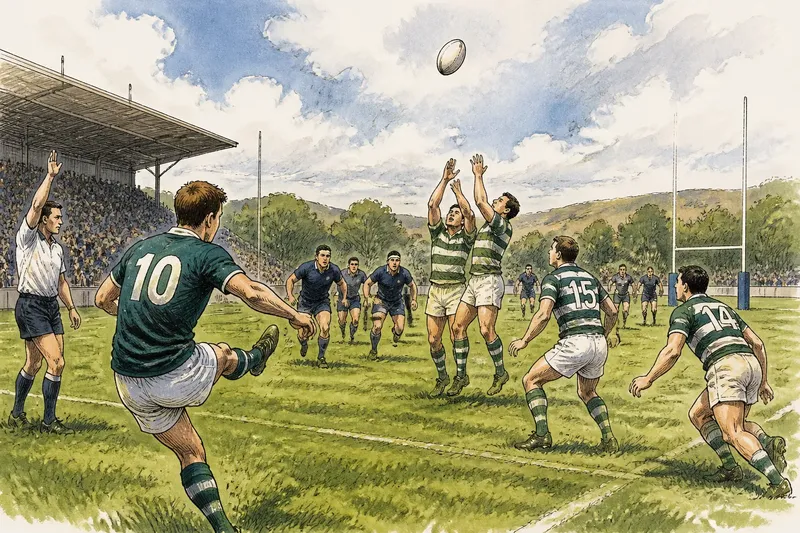
Who gets the ball after a score, and what should you watch next? At your first rugby match, a restart is a clear place to begin: follow the kick’s flight, then notice how each team responds as the ball comes down.
This guide focuses on kick-offs after scores. Other restarts have different conditions, so the referee’s signal and the competition’s rules determine what happens in a particular situation.
Rugby restart basics
In rugby union, the team that conceded a try normally receives the kick-off after the conversion attempt. The scoring team kicks the ball back into play. Exact restart procedures can depend on the type of score and the competition’s current laws, so treat this as the usual sequence rather than a rule for every situation.
The kick must meet the relevant requirements for a legal restart, including reaching the required distance. If it does not, the referee manages the resulting option under the laws. As a new spectator, you do not need to judge the kick yourself; the whistle and the referee’s signal tell you whether play continues or stops.
Both teams move as the ball travels, but their shapes vary with the kick, their tactics, and the players’ positions. Rather than assume a fixed formation, look at where players gather and how much space remains around the likely landing area.
Read the receiving shape
The receiving team may position players beneath the expected flight and place others nearby or deeper. A nearby teammate can help the catcher keep possession or make the next carry; a deeper player may be ready if the ball travels beyond the first group. These are possible roles, not clues to a single guaranteed plan.
The kicking team’s players may advance toward the ball, but their spacing and timing are not always uniform. A connected group can put pressure on the receiver, while gaps may leave room for a pass or run. Watch the players’ actual movement rather than assuming the whole team will spread out or advance in one line.
It is not worth the effort to identify every player’s position during the kick. Instead, notice whether the receiving side has nearby options and whether pressure arrives quickly. Those details help explain why the first action is a catch, pass, carry, or hurried clearance.
Follow the ball’s flight
A high kick gives players time to move toward its landing area. A longer kick may force the receiving side to retreat, while a shorter one can bring the teams together sooner. Wind, the bounce, and the kicker’s angle can alter the result, so the flight shows where play may develop, not exactly where the ball will land.
When the ball comes down, watch whether a player catches it cleanly, taps it, or has to react to a bounce. If possession is secure, the carrier’s first choice can show whether the team wants to run, pass, or kick onward. If the ball is loose, the nearest players’ reaction reveals where the immediate contest is forming.
Say you are watching an invented match: the receiving team places two players under a high kick and one farther back. The front player catches the ball, but an opponent closes quickly; a nearby teammate then takes the carry. You can follow how the catch becomes a pressured attack, while noting that a different bounce or defensive arrival could have changed the decision.
After a score
The pause after a score gives you time to reset your attention. Find the team preparing to kick, then look toward the players positioned to receive. When play resumes, follow the ball until its first clear outcome rather than trying to track every player across the field.
A secure catch, a loose ball, and a kick back downfield each send play in a different direction. The referee’s whistle can also interrupt a restart if a law has not been met. When that happens, listen for the decision and watch where the official indicates play will resume.
Rugby restart questions?
Who receives after a try?
Usually, the team that conceded the try receives the ensuing kick-off after the conversion attempt. Check the referee’s signal and match context, since restart procedures can vary with the situation.
Why do players move before the ball lands?
Players move to reach the ball or prepare for the next phase while it is in flight. Their positions may reflect a plan, but the kick’s length, direction, and bounce can change what they do.
What should I watch when the ball bounces?
Look for the players who react first and whether either side secures possession. The ball may travel away from its expected landing point, so follow its actual movement rather than the original target.
What if the referee stops play?
Watch the official’s signal and listen for the decision; the match may restart under a different option if the kick did not meet the relevant requirements. You can follow the next passage from the point the referee indicates.
Choose one cue
At each rugby restart, pick one detail to follow: the position of the receiving group, the direction of the ball, or the first choice after possession. Changing your cue from one restart to the next keeps the field readable without turning the match into a memory exercise.
Once the ball is in play, let what actually happens guide your attention. The receiving shape offers context, but the flight, bounce, referee’s decision, and players’ reactions determine where the passage goes next.