How Rugby’s Early Rules Became a Distinct Game
Rugby’s early rules took shape through school customs, written agreements, and club fixtures; follow that path to see how local football became a shared code.
How did rugby’s early rules turn school football into a distinct game? Rugby’s early rules developed as groups carried familiar ball games between schools and clubs, then settled on local agreements about how to play. The history is not a single invention story: it is a chain of customs, decisions, and matches.
School customs
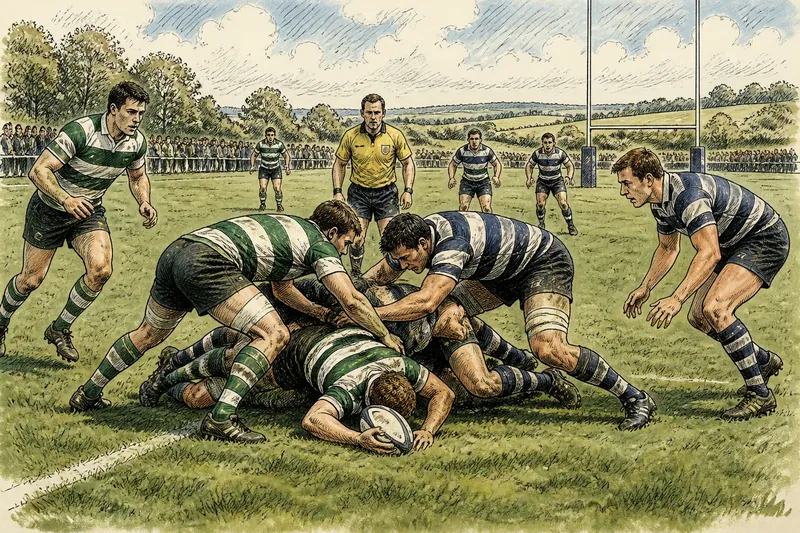
In the nineteenth century, football at British schools did not follow one uniform code. Rules and customs varied by institution, affecting how players could handle the ball, restart play, and score. A player moving between schools might find that a familiar game worked differently on a new field.
Rugby School became associated with a style that included handling and carrying the ball as well as kicking. That description is best understood as a broad account of the school’s tradition, not as evidence that every pupil followed one fixed, modern-style rulebook. Later accounts link the school’s distinctive play to those habits; the surviving origin story should not be treated as a complete record of every early match.
The school’s name became attached to a recognizable version of football, but that does not mean football began there or that rugby appeared fully formed on a particular day. The distinction grew as people repeated and discussed local practices.
Written agreements
When players took their preferred style beyond school, opponents needed to know what was permitted. A custom understood by one group could cause a dispute when another group interpreted the same action differently.
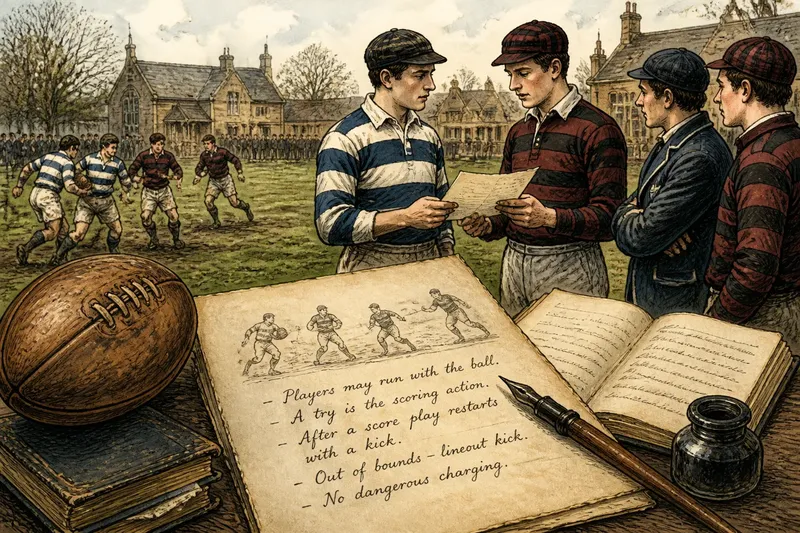
Writing rules down helped teams arrange matches and resolve those disagreements. It also required specific choices: whether a player could run while carrying the ball, what counted as a score, and how play resumed after a stoppage. Such decisions made one version of football more recognizable and distinguished it from other codes.
There was no clean, universal boundary drawn at once. Groups could favor different rules, and agreement took discussion. A code became clearer as its players could identify which actions belonged within it and which did not.
Clubs and fixtures
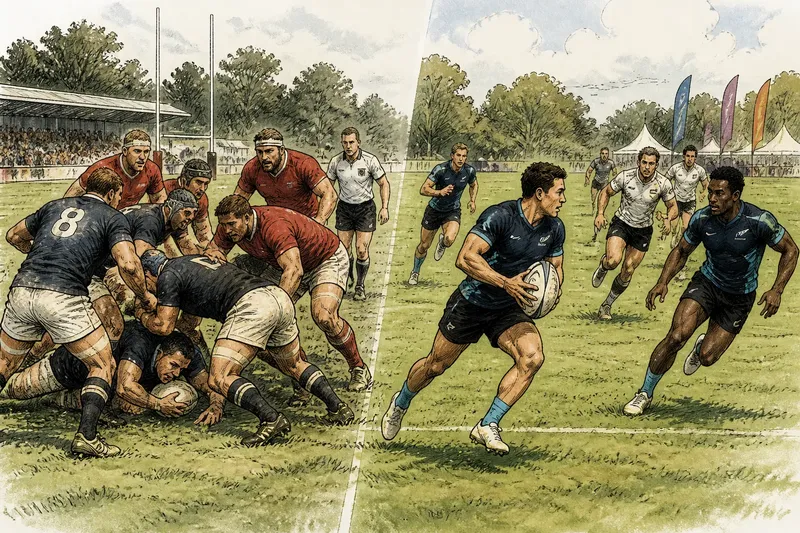
Schools passed on playing habits, while clubs provided a lasting setting outside school. Members could arrange fixtures, bring together players with shared expectations, and repeat agreed rules against new opponents. Those recurring matches helped make a local style portable.
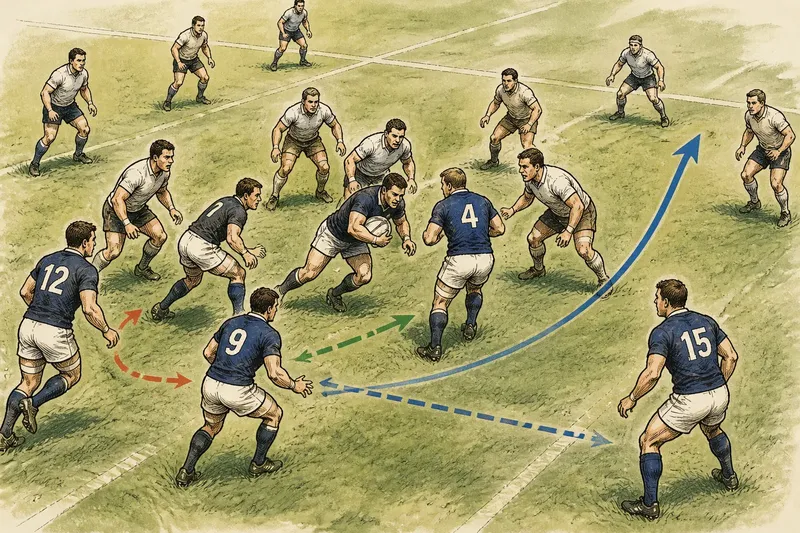
Imagine two invented teams, one accustomed to carrying the ball and one accustomed to kicking it. Before a match, their captains agree that players may run while holding the ball, that a try is the agreed scoring action, and that play restarts with a kick after a score. They write these choices on a match sheet and share it with both teams. The observable result is a contest in which players can prepare for the same rules; if either captain objects to a choice, they must revise the agreement or choose another code before play begins.
Club identity added a social dimension. A team represented its members and opponents as well as its rules. Fixtures made those relationships visible and gave players a reason to preserve a shared way of playing.
Rugby’s early rules?
Did rugby begin with one rulebook?
No single rulebook created rugby in one stroke. Its identity developed as schools and later groups recorded and negotiated rules that had previously varied by place.
Why did handling matter?
Handling and carrying the ball were among the habits associated with Rugby School’s style, alongside kicking. The exact permissions depended on the rules a particular group adopted.
How did clubs help rugby spread?
Clubs organized players and fixtures beyond school, giving groups opportunities to meet and repeat agreed rules. Those encounters encouraged teams to clarify their expectations before a match.
Was early rugby the modern game?
No. Early forms differed from the game played today, and the rules continued to change. It is more accurate to think of rugby’s early development as a changing set of practices than as the arrival of a finished sport.
Origins without shortcuts
“Rugby was invented at Rugby School” is a compact phrase, but it can hide the broader tradition of school football and the later work of clubs and rule-makers. The school’s association with a distinctive style matters, yet it is only one part of how that style became recognizable beyond its original setting.
It is not worth trying to assign every present-day law to one early decision. Rules changed over time, so a modern match cannot serve as a direct picture of the first versions. For rugby’s early rules, follow the more useful sequence: local customs supplied habits, written agreements clarified them, and fixtures gave teams a reason to share them.
That sequence also offers a practical way to read an origin claim: ask which school or group is being discussed, what rule choices are actually described, and how those choices traveled. The answer is usually more informative than a search for one inventor or one decisive match.