The Myth That Every Rugby Attack Must Go Wide
Rugby attack is not always about going wide. Learn how forward carries, short passes, and decoy lines can create clear choices for the next phase.
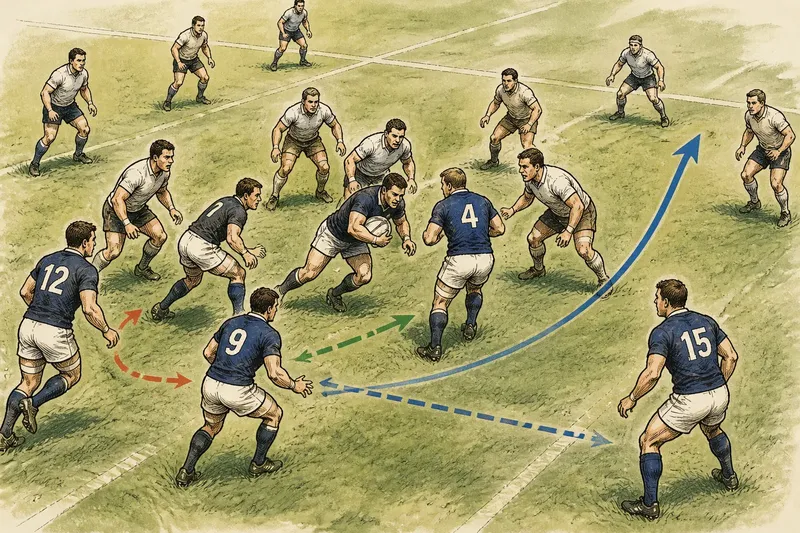
Should a rugby attack always send the ball toward the sideline as soon as it has possession? No: rugby attack works best when each pass or carry answers the defense in front of it. A forward run can preserve possession and shape the next phase, while a pass outside is useful only when the receiver has a workable option.
Width needs timing
A pass toward the touchline can give a team access to open grass, but the defensive line can move across while the ball travels. If the pass is slow or the receiver is standing still, the winger may catch it with little room to run. Width is useful when the attack can deliver the ball into a prepared channel before the defender there can close it.
Attacks can also use a forward carry to change where defenders must focus. Rather than treating this as a simple trade—more defenders near the ball means fewer at the edge—watch for the practical effect on the next phase: whether the ball is available quickly, whether the defense has reset, and whether the passer has a clear target. Those details shape the decision more directly than the location of the previous carry.
Think of each phase as a choice among routes. A carry can test the middle, a short pass can change the angle, and a wider pass can reach a receiver outside the immediate contest. The attack becomes hard to read when players keep these options credible without crowding the same channel.
Three attacking routes
Shift the ball early
An early shift suits a team with quick hands, useful spacing, and a clear outside target. It can also work when the defense has been slow to reorganize after a previous phase. The risk is that the ball travels farther than the defenders need to travel, leaving the receiver isolated or forcing a difficult pass near touch.
Before shifting, the ball carrier and nearby players should keep the defense occupied long enough for the outside receiver to get the ball in stride. Teammates also need to remain available behind the play in case a pass is intercepted, dropped, or followed by a tackle close to the line. Going wide needs a suitable launch point, not just an open-looking sideline.
Carry through the middle
A direct carry suits a team with a runner who can maintain control through contact and close support ready for the next phase. The goal need not be a clean break. A short gain can help the team retain the ball and give the scrum-half a clearer picture of the next available route.
Repeated carries on the same line can become easy to anticipate. To vary the picture, a carrier might run at a defender’s inside shoulder while a teammate stays available for a short pass. The attack can also change its point of approach on the next phase, rather than asking the same runner to repeat a route the defense has already read.
Use a short pass or decoy
A decoy is a player who runs a credible line to attract attention but does not receive the ball. The carrier may pass behind that runner to a teammate moving into a different channel. This option depends on timing: the supporting players must know who is carrying, who is drawing attention, and where the actual pass is intended to go.
A decoy is less useful if defenders can ignore the runner and still cover the intended receiver. The carrier also needs a safe alternative if the passing lane closes. A short pass or decoy should clarify the attack’s options, not add motion without a clear target.
Build useful support
Forwards can help shape an attack without every phase ending in a forward carry. One player can offer a close support line, another can prepare for a short pass, and backs can stay positioned to receive a shift if the ball is moved cleanly. The purpose is to keep the next action available, not to send every player toward the same contact area.
Support affects what the team can do after a tackle. A runner with teammates nearby may leave the ball ready for another phase; a runner without support may have no safe continuation. Players should judge a run by whether they can keep possession and make the next pass or carry promptly, as well as by the ground gained.
Imagine a team attacking near the center of the field. Its backs are spread, and a forward is close enough to support the ball carrier. The first forward takes a short line at a defender’s inside shoulder; two teammates arrive nearby. The scrum-half sees that the ball is available and that the backs are still in position, so the next pass goes outward. The expected observable result is a controlled shift from a supported carry, rather than a long pass made before the team is ready.
Read the defensive line
Before choosing a route, look at the defenders’ spacing, the position of the outside players, and how quickly the line advances or resets. Then check the attack’s own shape: whether a receiver has support, whether a forward is close enough to carry, and whether the ball carrier has time to pass.
- Check the outside channel: If a receiver has space and the ball can arrive before defenders slide across, shift it wide; otherwise, keep possession with a supported carry or short pass.
- Check close support: If a runner has teammates nearby and a clear route, carry through the middle; otherwise, pass to a positioned teammate or slow the attack until support arrives.
- Check the pressing defender: If a defender is advancing hard and a teammate can run behind that line, use a short pass or decoy; otherwise, keep the pass simple and avoid forcing it into a closed lane.
- Check the ball’s speed: If the ball is available cleanly and the backs are set, consider a wider shift; otherwise, use the nearest safe support option rather than a long pass.
- Check the receiver’s position: If the receiver is moving onto the ball with support nearby, pass to that player; otherwise, hold the ball or choose a closer target who can continue the phase.
- Check the defense’s reset: If defenders are still reorganizing, move the ball toward the clearest available channel; otherwise, change the angle with a short pass or carry before trying to shift it farther.
These cues are starting points, not fixed rules. A defense can disguise its intentions, and the best route depends on the players’ skills and the position on the field. Watching the ball’s availability and the support around it helps explain why one attack continues while another stalls.
How should you choose?
When is going wide the better choice?
Go wide when the outside receiver has room, the pass can arrive before defenders cover the channel, and support is available. A clear overlap or a defense that has not reset can make the edge the direct route forward.
Why carry if the defense is set?
A carry can help the attack retain the ball and prepare a quick next phase, even without a break. If the defense is close and organized, a predictable run may offer little; look for a support line or a different angle.
What does a decoy runner do?
A decoy gives defenders another credible line to account for while the carrier considers a pass to a different teammate. It works best when the runner’s timing is clear and the carrier can still make a safe decision.
What if the defense holds its shape?
If defenders hold their positions, the attack can use a close support option or change its angle rather than repeat the same route. The next action should suit the ball’s availability and the players ready to receive it.
Skip automatic shifts
Moving the ball wide just to show width is rarely worth the effort. If the defense has already shifted across, another pass may consume time and leave the receiver with fewer choices than the passer had. Forcing a forward carry simply to appear direct can also waste possession when the runner has no support.
Use forward play and width as connected options, but judge each phase by the immediate conditions. A supported carry can keep the ball available for a later shift; a wide pass can reach a receiver who is ready to continue. The useful search phrase, rugby attack, describes more than passing direction: it is the choice of a route the team can execute and support.