The Rugby Ruck and the Contest for the Ball
Understand the rugby ruck, its entry and offside rules, and the use-it call so you can follow how possession changes after a tackle.
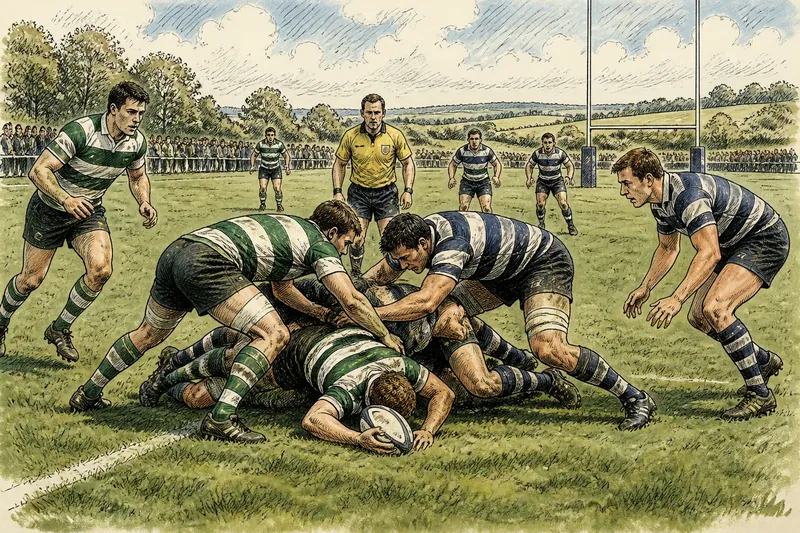
When a tackled player places the ball behind them and opponents close in, the rugby ruck can form before the next pass. To read the contest, watch when players make contact, how they enter, and where the ball lies; those details affect who may handle it and when defenders can move forward.
The tackle and ruck
A tackle and a ruck are separate events. A tackle occurs when a ball-carrier is held by an opponent and brought to ground. Under the applicable laws, the tackled player must release or play the ball, and the tackler must release the tackled player and move away or get up before playing the ball again. The exact requirements depend on the circumstances and the competition’s current law variations.
A ruck forms when at least one player from each team, on their feet, is in physical contact over the ball on the ground. A gathering over a tackled player does not by itself create a ruck: until opposing players make the required contact, the tackle-area laws still apply. This distinction matters because a player may be able to pick up the ball before a ruck forms, but a player who is part of a formed ruck cannot use their hands to play it.
Players at the tackle area must approach from their own side, through the gate. In broad terms, the gate is the space behind the feet of the players already involved. A player who enters from the side or beyond the opponent’s line may be penalized. Exact rulings turn on the player’s position, actions, and the referee’s view of the contest.
Entry and possession
The first support player can protect the ball by arriving upright and staying on their feet. That player must enter legally and cannot collapse the contest or use hands to play the ball once they are part of a ruck. An opponent can contest, but must also enter through the gate and remain on their feet while joining.
Before a ruck forms, a player who is onside and otherwise complies with the tackle laws may play the ball with the hands. Once opposing players on their feet are in contact over it, players in the ruck must not handle it. They may use their feet to move the ball, subject to the laws against dangerous play. A player outside the ruck can handle the ball once it is out and available to be played.
The tackled player and tackler have specific obligations, but their actions are not judged in isolation from the contest. A player on the ground cannot simply reach through opponents to play the ball; the referee considers whether the player has released, moved away, or otherwise complied with the relevant requirement. When bodies hide the ball, the referee’s position can make the difference between what a spectator sees and what the official can rule.
Offside and use-it
At a ruck, each team’s offside line is generally the line of the rearmost foot of that team’s players in the ruck. Players not in the ruck must stay behind their line until the ball is out or the applicable law otherwise permits them to advance. A player who is offside must not take part or interfere with play; they need to return onside before doing so.
The referee’s “use it” call applies when the ball is at the back of a ruck and the ruck has become stationary, under the conditions set out in the current law. The call directs the team to play the ball, rather than keep the ruck going. If the team does not play it within the period specified by the applicable law, the referee may award a scrum to the opposing team. Because law wording and competition variations can change, use the current World Rugby laws or the competition’s law variations for an exact ruling.
Do not treat every pause as an automatic use-it situation. The referee assesses whether the ball is available at the back and whether the legal conditions for the call have been met. If the ball remains trapped or the ruck is not in the relevant state, the response may differ.
Reading the next phase
A ruck affects how quickly the attacking team can get the ball to a receiver and how much time the defense has to organize. A clean presentation can let the scrum-half pass or kick before defenders have fully reset. A stalled contest can give the defense time to rebuild its line.
Defenders face a choice: commit players to contest or slow the ball, or leave more players available to defend the field. Committing bodies may make the next pass harder to deliver, but it also leaves fewer defenders in the line. Holding back can preserve the line while allowing the attack a cleaner release. The best choice depends on the ball, field position, and the teams’ plans.
Imagine an invented match near midfield: the tackled player places the ball behind their body, an attacking teammate arrives upright through the gate, and an opponent enters legally and binds onto that player. Once the two opposing players are on their feet and in contact over the ball, a ruck has formed; neither player in it can pick the ball up. If the attacking team keeps its feet and the ball reaches the back, the scrum-half can play it when it is out, while defenders remain behind their offside line. If the ball stays trapped, the referee may manage the contest rather than treat it as available.
Ruck questions?
Can a player pick up the ball before a ruck forms?
Possibly. A player who is onside and complies with the tackle laws may play the ball with the hands before the opposing players establish a ruck. Once a ruck forms, players in it cannot handle the ball.
Can a player enter from the side?
Players joining the tackle area must enter through the gate from their own side. Entering from the side or beyond the opponent’s line can lead to a penalty, depending on the circumstances and the referee’s view.
When is the ball out of the ruck?
The ball is out when it has left the ruck and is available to be played, rather than remaining within the contest. The referee judges whether it has emerged, so a scrum-half should not assume that a visible edge of the ball is enough.
What does the “use it” call mean?
It tells the team to play the ball when a ruck has become stationary and the ball is available at the back, subject to the applicable law. If the team does not comply within the period stated in that law, the referee may award a scrum to the opposition.
What not to overread
The number of players at a breakdown does not predict by itself who will win the next collision or where the ball will go. A single pass can change the defensive picture, and a team may choose a short carry rather than attack space immediately. It is also not worth trying to diagnose every infringement from a distant camera angle: feet and ball placement are often hidden, and the referee may have a clearer view.
For a useful read, notice when opposing players on their feet make contact over the ball, then track the entry, the ball’s availability, and the defenders’ offside line. The current laws and competition variations determine the precise ruling; that distinction helps you separate a clear visual cue from an assumption about what the referee must call.